
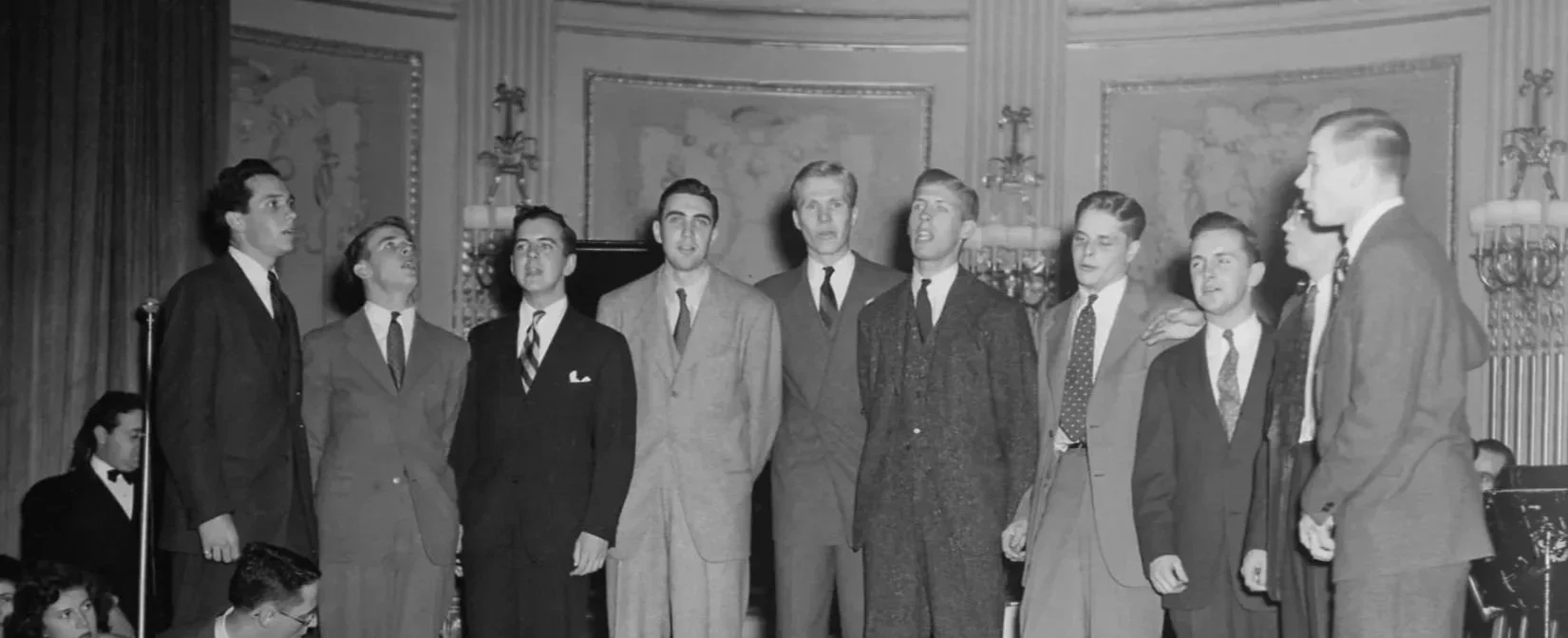
The Nassoons’ signature sound begins with a fifth voice.
The Pioneers of Five-Part A Cappella
For more than eight decades, the Princeton Nassoons have been known not only for their performances, but also for their distinctive musical sound, at the center of which is a tradition of five-part a cappella harmony. Since the group’s earliest years, the Nassoons have sung not in the standard four-part collegiate style, but with five core voice parts: Tenor 1, Tenor 2, Tenor-Baritone, Baritone, and Bass. The added inner voice of the Tenor-Baritone, or TB, is what gives Nassoon arrangements their characteristic density and color, allowing for fuller chords, more intricate inner lines, and the kind of close jazz harmony that has shaped generations of Nassoon music.
The resulting ensemble was one that departed from the dominant four-part barbershop style of mid-century collegiate singing while embracing the close, sophisticated harmonies of swing-era and vocal jazz groups such as the Hi Lo's and the Meltones. In that sense, the Nassoon sound has always lived somewhere between old and new: rooted in the classic collegiate singing tradition, but constantly pushing toward richer, more adventurous harmony.
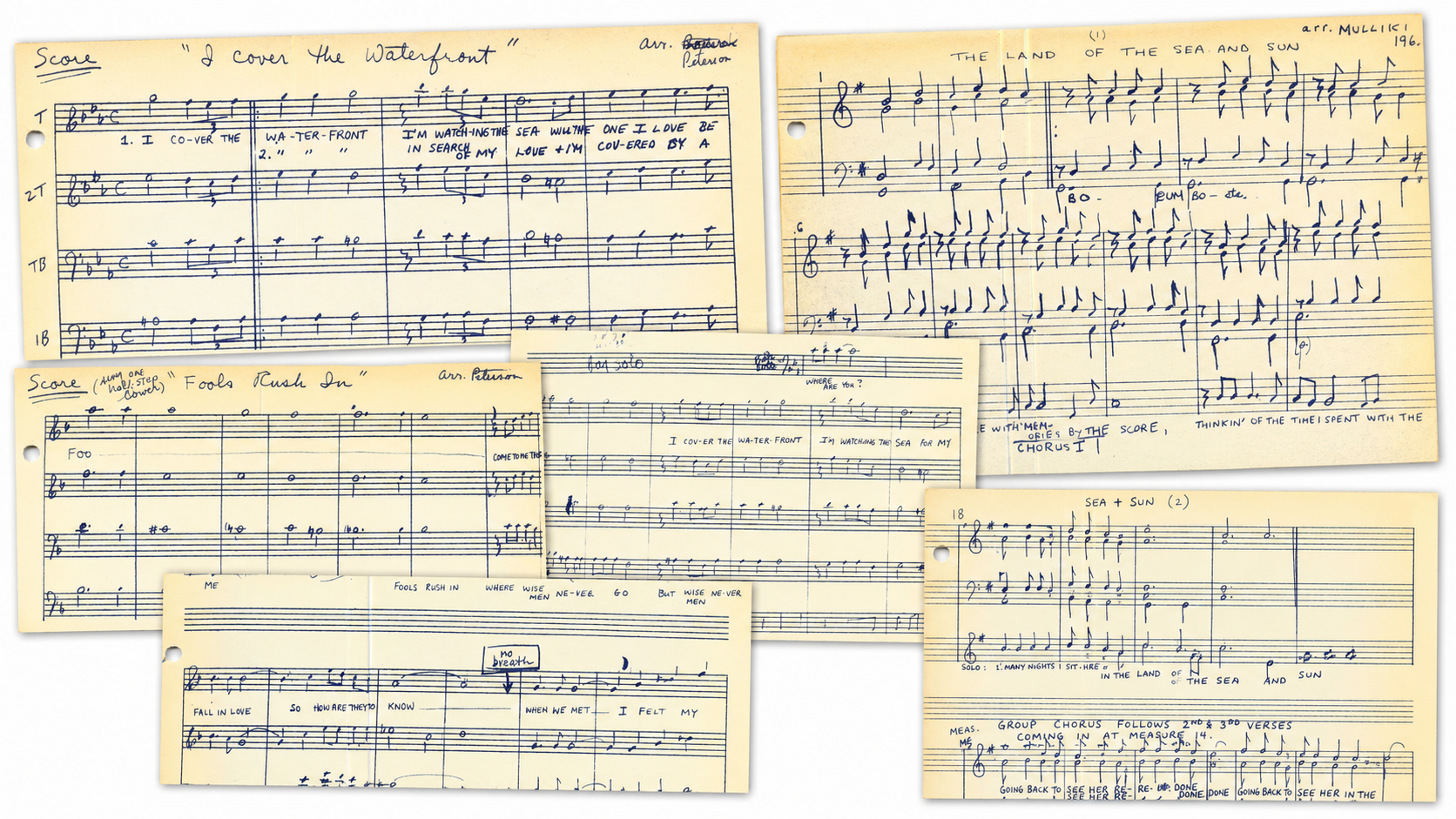
ARRANGERS OF THE NASSOONS
Although the Nassoons relied partly on barbershop standards and Princeton Glee Club arrangements in its infancy, members quickly began creating arrangements of their own. As Eric MacGilvray ’93 writes in Nassoons’ Seventy-Five Years of Music: A Music Bonanza, this became “perhaps the Nassoons’ greatest and most often overlooked tradition”: the tradition of original, in-house arrangements.
That tradition has shaped nearly every era of Nassoon music. James Lotspeich ’44, whose arrangements such as “East of the Sun” remain central to the repertoire, helped define the young group’s five-part sound and moved the Nassoons beyond the barbershop style favored by older collegiate groups of the time like the Whiffenpoofs. In the postwar decades, arrangers such as Ham Hamill ’51, Robert Morgan ’56, Dick Peterson ’60, Mac Mellor ’63, and Kent Mullikin ’64 created many of the lush ballads and intricate five-part arrangements that Nassoons still cherish today, such as “While My Lady Sleeps,” “I Cover the Waterfront,” “Danny Boy,” and “Shenandoah.” The ‘50s and early ‘60s in particular became a defining period for the development of the Nassoon sound, with clashing ninths, floating extensions, and a growing emphasis on flowing backgrounds behind solo lines.
However, the Nassoon sound has never been frozen in time. The ’70s brought pop, the ’80s brought rap, and by the ’90s, the group’s performances had grown to include choreography. Through it all, though, one thing remained constant: each class of Nassoons inherited a tradition, added its own voice, and left the music a little richer than it found it, without ever abandoning the five-part core of the group’s identity. Today, the group continues to arrange prolifically in the same spirit that has guided the Nassoons since the beginning: five voices, close harmonies, and a sound of our own.
Don’t just take our word for it — hear the Nassoons for yourself.